No more sit-down strikes! We’re going to paralyse the transit system.
A maintenance worker following the suspension of 73 of his colleagues on August 7, 1974
On June 26, the Centre de formation politique hosted a discussion on the pamphlet Ouvrons nos contrats, résistons aux injonctions (“Open Our Contracts, Resist the Injunctions”). Published in 1975 by the Groupe Socialiste des Travailleurs du Quebec in collaboration with the Montreal transit workers’ union, which was affiliated with the Confédération des Syndicats Nationaux, the pamphlet examines the summer 1974 strike by maintenance and garage workers at the CTCUM (the predecessor to today’s STM). This labour dispute deserves to be studied and reflected upon by all members and supporters of Workers’ Alliance, as its course so clearly illustrates the essence of a political strike. The workers effectively leveraged their central role in the company’s operations—namely, the maintenance of vehicles that transport a significant portion of Montreal’s working-class population—to assert their interests beyond the labour code and the laws dictated by the elite. They did this by ceasing to work.
Background
In August 1974, 1,600 maintenance and garage workers at the Montreal Transit Corporation went on strike following the suspension of 73 of their colleagues who had refused to work on the June 24 and July 1 public holidays. This refusal followed a directive from the Montreal Transit Union, representing maintenance workers, to use this tactic in response to the CTCUM’s resolution not to reopen the collective agreement. The purpose of reopening the agreement was to amend the wage clause that had been initially negotiated. Against a backdrop of rampant global inflation, the federations had recommended in March 1974 that their affiliates “reopen their collective agreements or decrees with a view to obtaining wage indexation to the cost of living and the back pay they deem appropriate.”1
This was not a recommendation that echoed only in the minds of union bureaucrats. At the time, several thousand workers—including white-collar employees and firefighters in Montreal, as well as workers at United Aircraft and Christie—mobilised to demand that their collective agreements be reopened so their wages could be indexed to inflation, which had reached 12% in 1974. In total, 500,000 Quebec workers were then calling for such a reopening. The labour federations therefore appeared to be more supportive of a movement driven by a solid working-class base. It should also be noted that, even at that time, the CSN’s union leadership favoured “social dialogue” over pressure tactics democratically exercised by the working class. The federation’s executive did in fact propose a three point strategy for fighting the decline in purchasing power:
1) engage in discussions with employers at the sectoral level;
2) request a general meeting involving employers, the government, and unions. CSN leadership cited the 1968 Grenelle Agreements in France as an example;
3) launch a campaign to convince the government to adopt legislation providing for cost-of-living adjustments across the board, for wage earners as well as for pensioners and welfare recipients.2
The Labour Code: A Result of the Class Struggle
A remarkable feature of this labour dispute was the head-on confrontation between CTCUM employees and Quebec’s legal system. At the time, back-to-work injunctions issued by judges had become a major obstacle for the labour movement.3 On the very first day of the strike, August 7, the Montreal transit authority obtained an injunction ordering employees back to work. The union leadership responded quickly and courageously: it called a meeting during which, against the advice of the union council, it proposed that the members present defy the injunction. Ultimately, members voted by majority to do so. The union leadership then relied on “solidarity and mass action” to uphold this decision.
As a result, over the 44 days of the strike, a record number of contempt-of-court charges were laid: 234 in total against the maintenance “boys”. On August 20, the union was fined $50,000, and members charged with contempt received individual fines ranging from $50 to $750.
The extraordinary nature of the situation becomes clear when reading the remarks made by bourgeois legislators and officials throughout the strike.
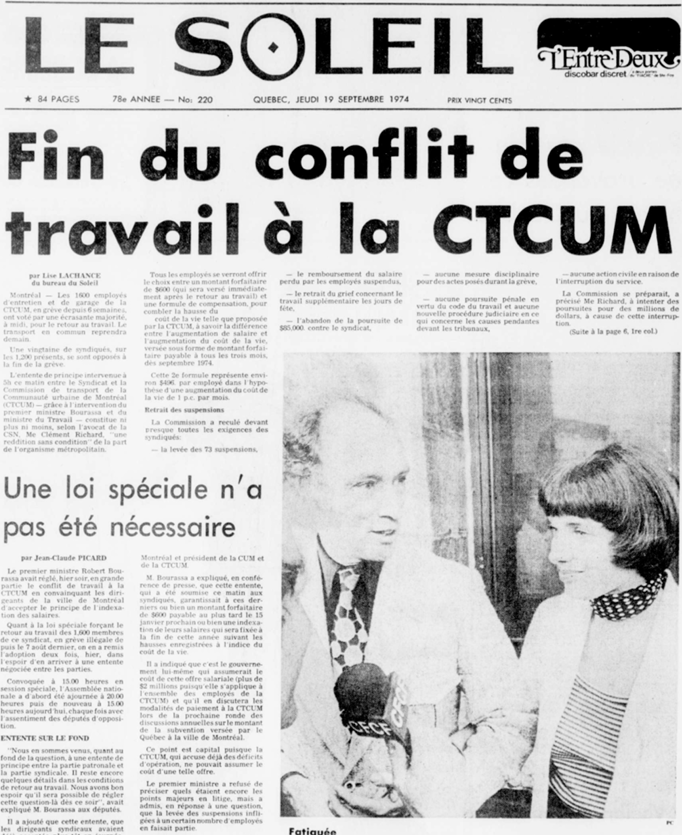
The city administration was overwhelmed by the mounting number of contempt-of-court violations. In September, Mayor Drapeau and the director of the CTCUM concluded that there was no need to pass special back-to-work legislation, since the maintenance workers were not complying with court orders in any case. The two men attempted, unsuccessfully, to impose a legal solution on the conflict.
After two weeks of striking, the provincial government appointed Lucien Saulnier as an investigator tasked with finding a resolution to the conflict. Saulnier drafted a report in which he concluded that the strikers were demanding wage indexation to inflation “on the grounds of fairness, not law,” and that this demand was driven by a social movement that governments could not ignore. He therefore recommended that the demands of the “boys from maintenance” be met.
On September 16, the workers accused of repeated contempt of court appeared before Chief Justice Deschênes of the Superior Court. Deschênes delivered a ruling that highlighted the social dimension already identified in the Saulnier report. More specifically, he noted that the workers were demonstrating “a newfound unity and solidarity” and that they “had realised they could bring the judicial system to a standstill and make political governance impossible”! He added the following observations:
The use of contempt of court proceedings following an injunction, while it remains suited to resolving private disputes, no longer meets, as a general rule and barring exceptions, the demands of our time in the field of collective disputes. We can—and even should—yearn for the time when respect for the law was ingrained in social custom and the authority of the courts commanded popular assent. But yearning is fruitless.4
This amounted to a significant concession. The chief justice seemed to recognise that labour law was the product of class struggle and that, under the circumstances, workers’ power had rendered it obsolete.
Even when the Bourassa government considered a special bill in September, his cabinet sought to find a truly negotiated solution to the dispute. It appeared risky to force a return to work while the strikers were widely defying the injunctions and while the special legislation could potentially have included other contemporary labour disputes being carried out outside the legal framework. The risk of the situation spilling over was, it seems, too high.
No less capable than those who came before us
On September 18, the workers emerged triumphant. They secured wage indexation to inflation, the withdrawal of the 73 suspensions, and the repayment of wages lost by the suspended employees. Although the strike came at a high cost for the maintenance workers, with some losing more than $1,000, CSN counsel Clément Richard described the outcome of the dispute as an unconditional surrender by the CTCUM.
During the CFP discussion, the million-dollar question quickly arose: how were workers back then able to achieve such a high level of mobilisation when, today, political strikes seem like a distant tool in which we place many of our long-term hopes?
To offer that the attitude was simply more combative back then is rather trivial. Certainly, if there were more hard-fought union struggles at the time, workers were more combative. But why were there more hard-fought struggles? A satisfying answer would take significant historical research. Here, however, we can point to two factors.
The pamphlet notes that the leadership of the maintenance workers’ union was made up of militant and experienced activists. At the turn of the 1960s, a series of political events led Quebec activists to reflect on the drivers of effective political action and draw the appropriate conclusions. Many of these activists later became involved in trade unions and neighbourhood groups, guiding them toward more effective political action. The journal Mobilisation, numerous workers’ committees, such as the FUT, which played an active role in the occupation of Sept-Îles, and the radicalisation of neighbourhood popular committees all bear witness to this. It is worth noting that Jacques Beaudoin and Pierre Arnaud—the union president and the union representative for the maintenance workers, respectively—had been active in the Front d’Action Populaire, a municipal movement designed for workers, whose motto was “Workers in power”.
The pamphlet also highlights the importance of union solidarity to the success of the maintenance workers’ strike. More than 60 unions, from both the private and public sectors, joined the workers on the picket lines. In September, bus drivers, who were not on strike themselves, refused to cross the picket lines, even under police escort. It should also be noted that the leadership of the bus drivers’ union was hostile to the strike and acted as a classic “business union” throughout the dispute.
Taken together, these two factors suggest that the maintenance workers’ militancy was partly the product of years of organising by experienced labour activists. These activists had acquired invaluable experience and knowledge during the 1960s. They had become convinced of the need for a more direct confrontation between workers and the state to advance workers’ demands. Each of these confrontations offered workers an opportunity to realise that the game was rigged. Parliament could always pass legislation forcing wage earners back to work against their will. Such confrontations had the potential to strengthen labour struggles rooted in workers’ collective power and carried out outside the legal framework. This helps explain, at least in part, the remarkable solidarity shown by workers at the time.
The geopolitical, economic, and environmental instability of today is undoubtedly at least as great as it was in the 1970s. What we seem to lack today are the subjective conditions for mobilisation, namely, genuinely collective forms of organisation. These forms of organisation must reconnect political activity with the central social activity of our lives: work. We must move beyond weekend activism. This is the difficult task our organisation has set for itself. We can do it. We are no less capable than our parents and grandparents.