By refusing to handle weapons shipments, Genoa dockworkers are laying the groundwork for working class resistance to the bosses and the imperialists.
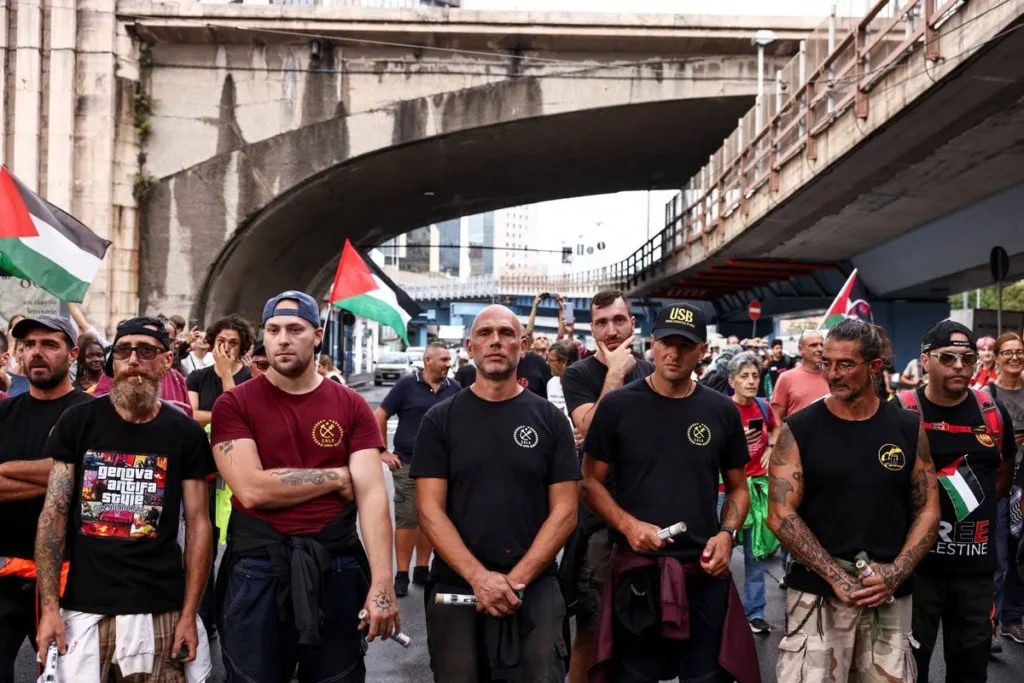
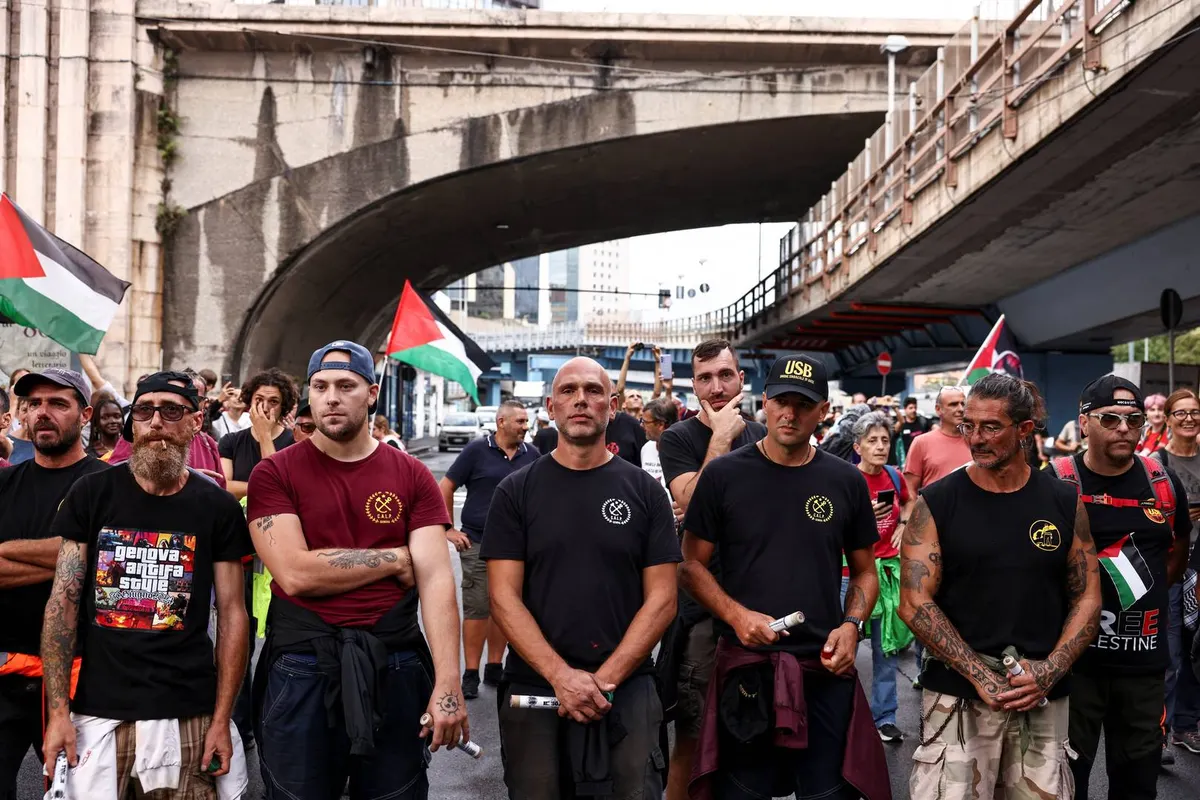
If, even for just twenty minutes, we lose contact with our comrades aboard the flotilla, we will shut down all of Europe: from the docks of Genoa, not a single nail will leave. It will be a global strike.
Riccardo Rudino, CALP member, August 30, 2025
On May 7, Italian ports will grind to a standstill. Following the call of the Collettivo Autonomo Lavoratori Portuali (CALP), based in Genoa, dockworkers will lead the charge against the Meloni government and the international bourgeoisie’s militarist agenda. Indeed, rearmament, elevated into an industrial policy, is not unique to our Prime Minister, Mark Carney, whose government massively increased military spending in its latest budget, widening the deficit to $78 billion.1 It is a project being pursued simultaneously by Western capitalist states, which are facing a profound economic and political crisis and which pit workers against one another rather than confronting the urgent crises that threaten our collective future.
The dockworkers’ strike seeks stronger health and safety measures, with workers directly involved in implementing them, improved wages and working conditions, an end to the precarious employment of temporary workers, a halt to the transport of military equipment through civilian ports, and a total embargo on goods shipped to Israel.
For seven years, CALP has been fighting against unjust wars by refusing to handle ships carrying weapons. They initially used this political lever of the working class to block arms shipments from the Saudi company Bahri Logistics, which were destined to fuel the violent Saudi and Emirati campaigns against the Houthis.2 More recently, CALP dockworkers disrupted weapons shipments intended for use in the genocide of Palestinians. They were also responsible for initiating last October’s general strike, in response to the interception of the Sumud flotilla bound for Gaza on October 3, 2025. The strike, it should be noted, mobilised more than 2 million Italian workers and students. They brought key parts of Italy’s infrastructure to a standstill, blockading numerous ports (Naples, Salerno, Livorno, Genoa), train stations (Porta Nuova, Centrale, Cardona, Termini), universities (Milan, Bologna, Rome’s Sapienza), and highways (A4, RA1, A51).3
Founded in 2011 by workers frustrated with the refusal of CGIL (Italy’s main trade union federation) to support the student movement against Berlusconi, CALP initially took a position in favour of cross-category and inter-company union organising. This stance marked the emergence of a common struggle among workers from the dozen or so companies operating in the port of Genoa.
The autonomous organisation cut its teeth by fighting for wage equality, the dignity of immigrant workers, and job security for all. CALP quickly opened a gym for its members, who regularly faced attacks from fascist thugs associated with the CasaPound group, which was not afraid to resort to violence.4 It also opened a restaurant at the port that served as a space for political organising and social gathering.
In the face of precarious employment, fascist attacks on striking migrant workers, Meloni’s authoritarian reforms, and the drive toward war, CALP has positioned itself at the forefront of the struggle, transforming the workplace into a political lever. Its work does not stop at local struggles: it has expanded to other Italian ports, helped establish another dockworkers’ collective in Livorno, forged alliances with autonomous activists in various territories to defend social centres from police repression, and joined dockworkers in Marseille, Tangier, and Thessaloniki in their workers’ embargo against the Zionist entity.
For workers, solidarity is more than a noble sentiment. It is the foundation of class cooperation in pursuit of our material interests and, ultimately, of a world where equality, freedom, and a good life are grounded in reality. As the bosses’ offensive continues and imperialism pushes the working class toward a global military confrontation, CALP’s dockworkers offer an example to workers everywhere.
- Maxim Fortin and Guillaume Tremblay-Boily, “Budget fédéral 2025 : un Canada assujetti au secteur privé et à l’industrie militaire“, Institut de recherche et d’informations socioéconomiques (IRIS), November 4, 2025. ↩︎
- “We Can’t Be at Peace with Ourselves If We’re Complicit in Saudi’s War’: Interview with Collettivo Autonomo Lavoratori Portuali“, translated by Bethan Bowett, Jacobin, February 15, 2020. ↩︎
- Necva Taştan Sevinç, “Italy Paralyzed by General Strike Observed in Solidarity with Gaza Flotilla,” Anadolu Agency, October 3, 2025; Gavin Blackburn and Giorgia Orlandi, “Italy paralysed by nationwide strike in solidarity with intercepted Gaza aid flotilla,” Euronews, October 3, 2025; Laura Serloni and Rory Cappelli, “Sciopero per Flotilla e Gaza, due milioni in piazza. Piantedosi: ‘Da Cgil appello a rivolta sociale’,” la Repubblica, October 3, 2025. ↩︎
- For example: “Ciampino, Maxi-Rissa a un Concerto. I Testimoni: ‘Aggrediti dai Fascisti’,” la Repubblica, June 7, 2012. ↩︎